INDIA & GLOBAL RANKINGS
# The Measuring Stick Is Broken
12 Oct 2026 • 8 min read
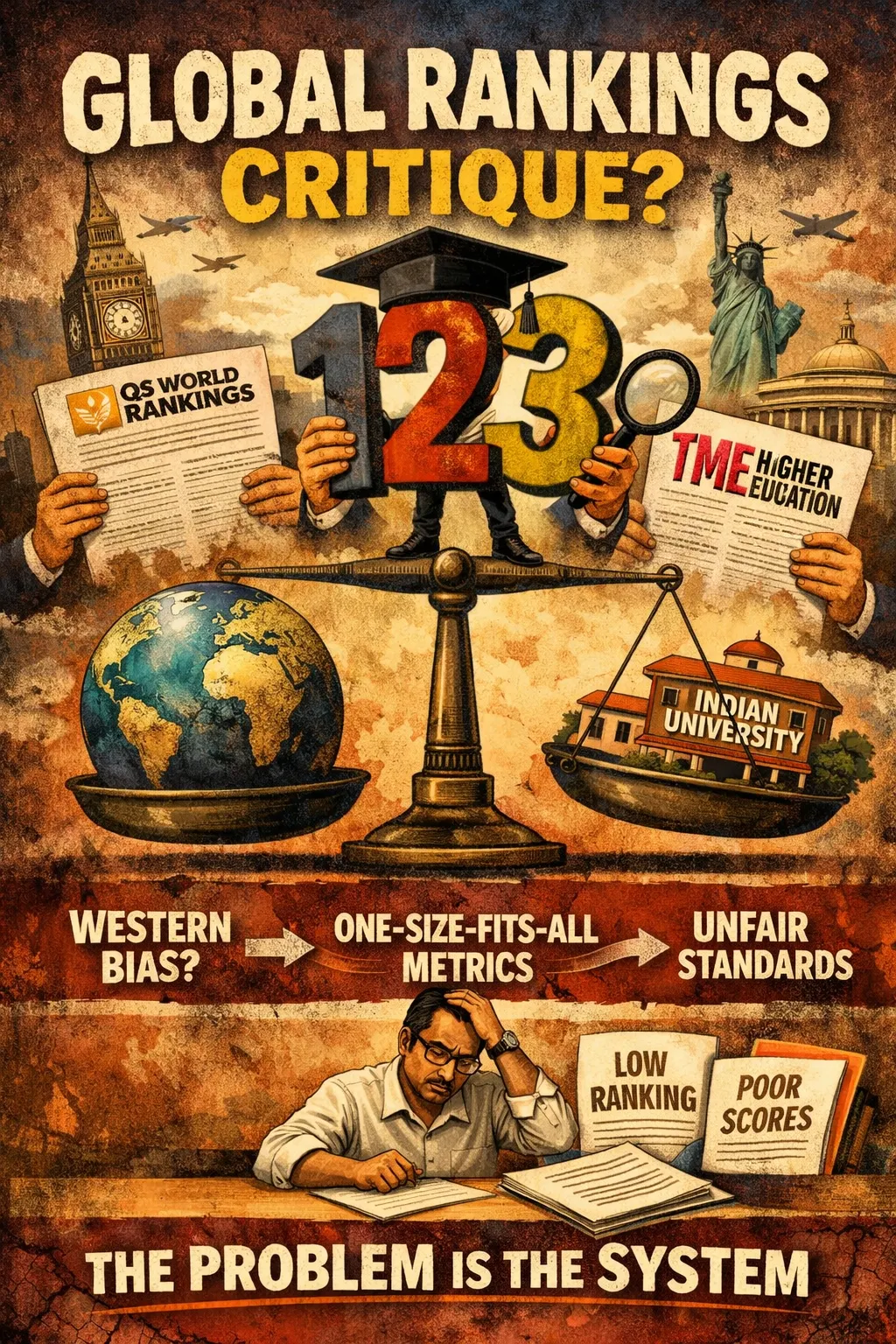
There is a particular kind of arrogance embedded in a number. It masquerades as objectivity. It carries the weight of institutions behind it. And when it arrives with a Western postal address, we tend to treat it as gospel. For over two decades, India has measured the worth of its universities against the QS World University Rankings, the Times Higher Education (THE) index, and the ARWU Shanghai list — three instruments designed, calibrated, and owned by the Global North — and found itself wanting. The conversation has proceeded as if the problem lies squarely with Indian institutions. It does not. The problem lies with the instruments.
Measuring the Wrong Things, for the Wrong World: Global university rankings rest on a handful of metrics. Academic reputation accounts for 40% of QS scores, employer reputation 10%, faculty-to-student ratio 20%, citations per faculty 20%, and proportions of international faculty and students 5% each. Read that again. More than half the score derives from reputation surveys and internationalization ratios — neither of which measures what a university actually teaches, or what its graduates build.
Reputation-based metrics tend to reinforce established hierarchies rather than reflect current institutional performance. Language and regional biases have also been documented, particularly the favouring of institutions in English-speaking, high-income countries, thus marginalising universities with strong local missions in non-Anglophone contexts. India’s universities serve 1.4 billion people across 22 constitutionally recognized languages. Their mission is civilizational, not cosmopolitan. Penalizing them for low international faculty ratios is like judging a monsoon by how little snow it produces.
The citation bias compounds the injury. A common criticism of global rankings is that they favor universities which publish in the English language, because most journals counted by bibliometric databases are in English. In addition, Anglo-Saxon academics have a greater culture of citing each other’s work than academics in other countries. Indian scholarship in mathematics, philosophy, linguistics, law, and the social sciences — much of it non-English, much of it oriented toward Indian realities — is simply invisible to the machinery of rankings. Invisible does not mean inferior.
The Boycott That Revealed the Truth: When seven of India’s most distinguished institutions — IIT Delhi, IIT Bombay, IIT Kharagpur, IIT Kanpur, IIT Madras, IIT Roorkee, and IIT Guwahati — chose to withdraw from THE World University Rankings, the system’s defenders called it pique. It was actually diagnosis. IIT Delhi and IIT Bombay were placed in the 401-500 band by THE, and the Indian Institute of Science at 301-350 — yet in QS, IIT Delhi ranked 182nd, IIT Bombay 152nd, and IISc 184th. The same institutions, the same faculty, the same research — producing radically different scores depending solely on whose formula you use. When the ruler keeps changing, the wall is not the problem.
Rankings measure inputs. The world is moved by outputs. And here, Indian universities have produced results that no citation index can contain.
IITs’ influence extends globally. Silicon Valley’s biggest companies are run by “IITians” — Sundar Pichai (IIT Kharagpur) leads Alphabet, and Arvind Krishna (IIT Kanpur) chairs IBM. In 2005, the U.S. House of Representatives honored IIT graduates for their contribution to American society. This is not a footnote. The United States Congress formally acknowledged the economic and civilizational contribution of Indian engineering graduates — graduates from institutions that cannot breach the top 150 of a global ranking.
The numbers grow more striking at the institutional level. IIT Delhi alumni have founded over 2,400 companies globally, raised $92.7 billion in funding, and among India’s first hundred unicorns, 30 founders came from this single campus — more than from any other institution in the country. A single campus. $92.7 billion. Thirty unicorns. No ranking methodology captures this. None attempts to.
Internationalization metrics can be inherently biased toward universities in developed countries, because these institutions often have the resources and reputation to attract international faculty from developing countries, while the opposite is less common. India’s universities do not import talent — they export it to power the economies of nations that then rank those same universities poorly. The irony is not subtle.
Scale, Access, and the Unranked Miracle: There is a dimension that rankings ignore entirely: scale. India operates the second-largest higher education system on earth, serving students from villages, from scheduled communities, from the first generation in their families to ever enter a classroom. The social engineering required to hold this system together — through reservations, regional-language instruction, distance education, and open universities — is an intellectual and administrative achievement of the first order. No ranking awards points for democratic access or for the sheer moral ambition of educating a sixth of humanity.
The Indian higher education system is one of the largest and fastest-growing in the world. Despite rapid growth in the number of institutions and enrollments, Indian universities have been generally missing from the top 200 positions in global rankings. The juxtaposition is telling. India builds. India grows. India democratizes. And the rankings continue to reward prestige, endowment, and English.
What India Needs: Not a Better Rank, but a Better Argument: The answer is not to game the system — inflating self-citations, manufacturing international collaborations, or paying per paper published, as some private institutions have already done with damaging results. The answer is to reframe the argument entirely.
India needs its own evaluative framework — one that measures graduate employment in high-impact sectors, entrepreneurial output, research translation into public benefit, multilingual knowledge production, and contribution to national development goals. The NIRF is a beginning, but a timid one.
The deeper truth is this: a ranking system designed by the Global North, for the Global North, calibrated on the assumptions of the Global North, cannot honestly evaluate institutions built on different civilizational premises, serving different populations, under radically different resource constraints. India is not failing global rankings. Global rankings are failing to comprehend India.
The measuring stick is broken. It is time India built its own.
More Blogs
LETTER TO OUR POLITICIANS

Dear Leaders and Custodians of Governance

HAPPY FRIENDSHIP DAY

The King Who Ran Barefoot: Friendship’s Long Journey From Sudama to the Insta Feed — #happyfriendshipday
KARGIL VIJAY DIWAS

# Kargil Vijay Diwas: The Sunday We Could Not Spare