HAPPY FRIENDSHIP DAY
The King Who Ran Barefoot: Friendship’s Long Journey From Sudama to the Insta Feed — #happyfriendshipday
08 Oct 2026 • 5 min read
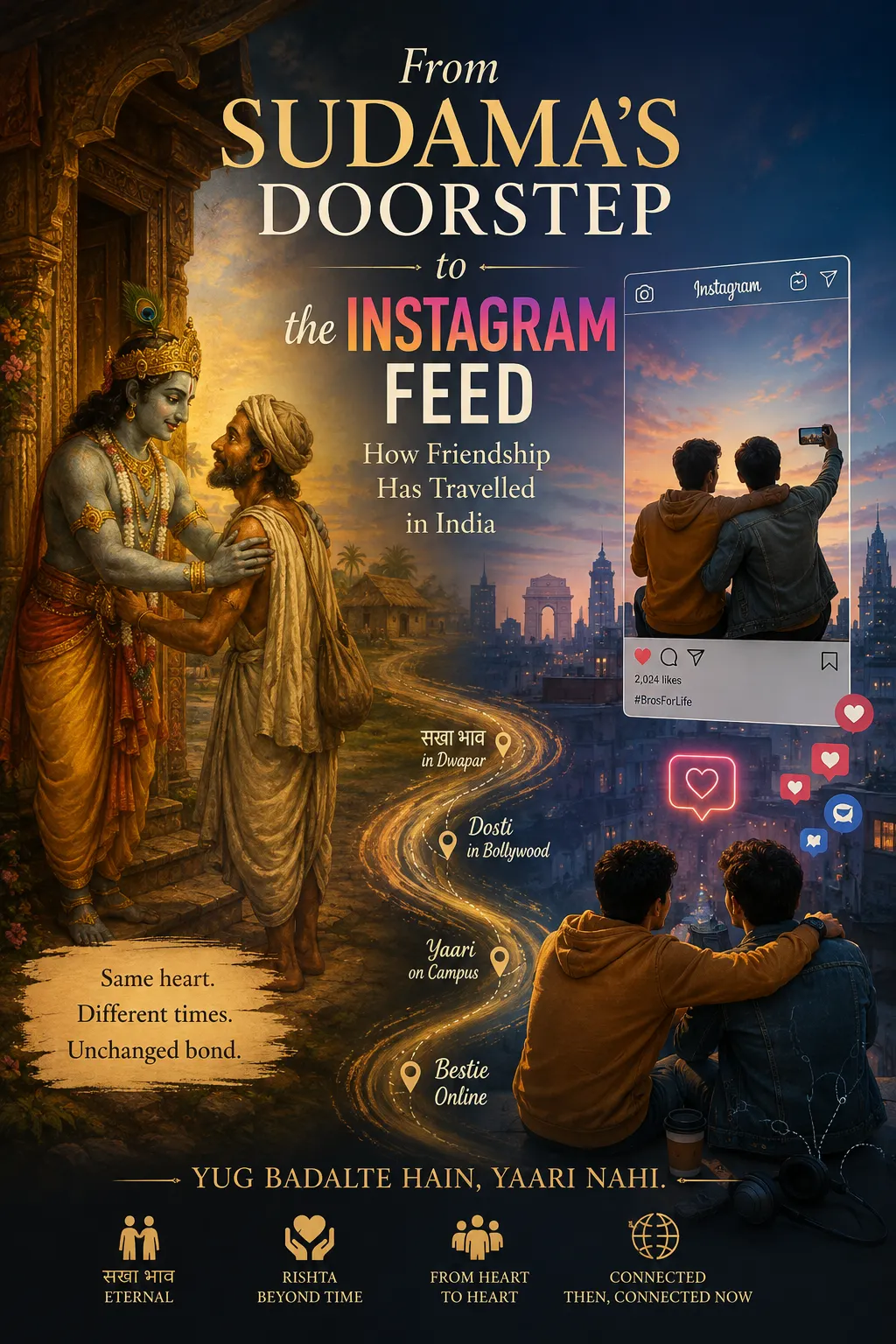
There is a moment in the Krishna-Sudama story that should stop every reader mid-breath. Krishna, the ruler of Dwarka, hears that an old friend stands at his gate — poor, threadbare, ashamed of the flattened rice he carries as a gift because he has nothing better to offer a king. And Krishna does not send a servant. He runs. He runs barefoot from his own throne, arms open, and washes the dust from Sudama’s feet with his own royal hands, weeping as he does it. Not because protocol demanded it. Because thirty years of silence had not touched what they once were to each other.
That image — a king on his knees before a poor man, both of them in tears — is the ache at the heart of every Indian friendship since. We have spent three thousand years measuring our friendships against a love that needed no reminder, no upkeep, no proof.
And then we built a world that runs almost entirely on reminders. Once, friendship was written into the geography of a life. It lived in the gurukul, where boys shared a floor, a fire, and a guru’s discipline. It lived in the joint family courtyard, in the mohalla where every mother knew every child’s cry. You did not choose these people. You were simply, helplessly, woven into them, the way a root grows into soil it never selected. There was no ache of choosing wrong, because there was no choosing at all — only years, pressing two lives closer until they became difficult to separate.
Then came distance, and with it, an entirely new kind of longing. A letter took a week to arrive, and when it did, it was read until the folds wore thin — read at night, by lamplight, sometimes with tears no one else was meant to see. A trunk call was booked days in advance, and when the line finally connected, a voice crackling three hundred miles away could make a grown man’s hands shake. Every word cost something. So every word was chosen like a jewel, and friendship survived not despite the distance, but almost because of it — because scarcity taught people what to treasure.
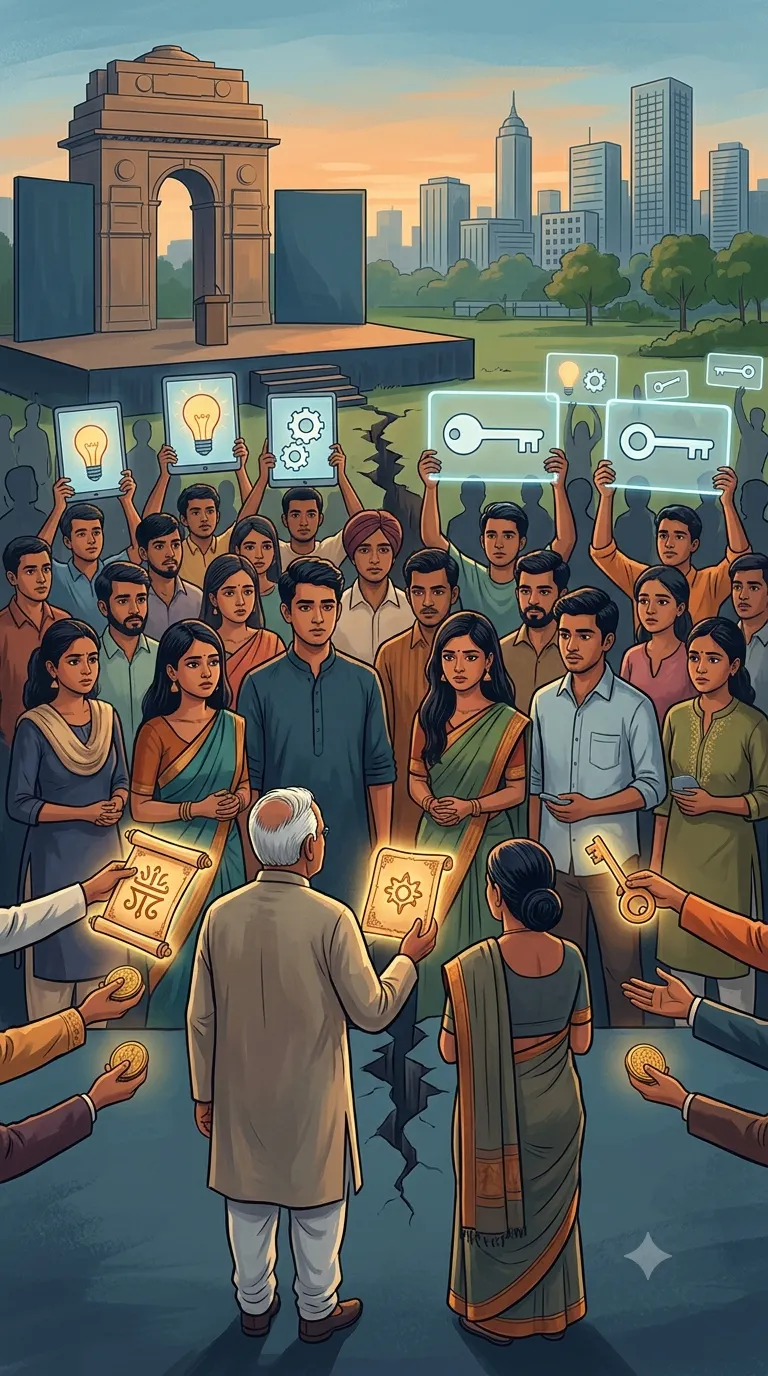
Now the distance has vanished, and so, quietly, has the ache. A message reaches its destination in less time than it takes to finish the sentence. A birthday is remembered not by a heart that carried it all year, but by a notification that fires at midnight whether we asked it to or not. “Friend” is now a button. A relationship can be summoned and dissolved with the same flick of a thumb that once, on a screen this small, held nothing more sacred than a photograph. We call three hundred people friends and mean, if we are honest with ourselves, four.
It would be so easy, here, to grieve. To say that something holy has been cheapened, that Sudama’s flattened rice has been replaced by a heart emoji that costs nothing and means less. Many will say exactly this, and there is real pain underneath their words — the pain of watching something that once required your whole chest now require only your thumb.
But sit with it a moment longer, and a different truth emerges, quieter but just as real. That grandmother in her village, who knew three hundred faces and trusted four with her secrets — she was not so different from her great-granddaughter scrolling through three hundred names tonight. The proportion of true friends to acquaintances has perhaps never changed at all. What has changed is that we can finally see the acquaintances — all of them, every day, glowing on a screen — where once they simply faded into the background of a life too small to notice them.
Perhaps what has truly been lost is not depth, but scarcity — and what has been gained, almost without our noticing, is witness. Sudama walked for days, alone, uncertain if he would even be received. Today, a message reaches someone in a heartbeat, and yet somewhere in that ease, the walking — the waiting, the not-knowing, the risk of showing up empty-handed and afraid — has quietly disappeared.
So we are left standing at a threshold not unlike Sudama’s own: unsure whether what we carry today is enough, unsure whether the friend on the other side will run to meet us the way Krishna once did. Perhaps every generation asks this same trembling question in a different language. Perhaps the deepest friendships — however they are carried, by foot, by letter, by trunk call, by a small blue light on a phone screen at 2 a.m. — will always be the ones where someone is still willing to run.
On friendship, memory, and the many meanings of ‘mitra’ in a connected India, this is the question we carry forward: what kind of love survives the age of speed? What kind of friendship still knows how to run?